Jood Piece Combat Guide: Power Types, Haki Activation and Skills
Jood Piece's confirmed combat power types include melee, sword, special and devil fruit — how to turn Haki on, the stat point condition that makes it work, and how the Doraemon showcase's letter-key skills fire in battle.
Quick answer
Jood Piece labels its purchasable combat powers with a TYPE. Confirmed catalog types include MELEE, SWORD, SPECIAL and DEVIL FRUIT, and each power is collected by talking to its specific NPC on a named island. You activate Haki with the on-screen button that appears once you own it — but Haki only adds damage after you have allocated stat points into the power you fight with. In the Doraemon showcase, skills fired from letter keys: Z, X, C and V each triggered a different skill.
- MELEE: Akaza, Homelander, Sukuna. SWORD: Kirito, Vergil. SPECIAL: Itachi, Gojo, Kokushibo. DEVIL FRUIT: Luffy (Gear5).
- Example NPC islands from the catalog: Kirito on Starter Island, Luffy (Gear5) on Cloud Island and Gojo on Event Island. Each entry also lists the power's named skills, usually four or five.
- That letter-key layout was shown for Doraemon only; other powers' keybindings weren't shown, so open your power's skill list and test each key.
- In one recorded test, damage stayed at 15 with Haki on before any stat points were allocated; the bonus only applied after the player raised the stats for the power being used.
Combat power types
Jood Piece sells its combat powers as gamepasses, and the catalog entries for those powers carry a TYPE label saying which category of combat the power belongs to. Confirmed catalog types include MELEE, SWORD, SPECIAL and DEVIL FRUIT. The label tells you what kind of kit you are looking at before you commit — a melee brawler like Akaza, a sword style like Kirito, a special like Gojo, or a devil fruit transformation like Luffy (Gear5).
Combat power types and example powers
- Type
- MELEE
- Example powers
- Akaza, Homelander, Sukuna
- NPC island from the catalog
- Akaza: Slayer Island. Homelander: USA Island. Sukuna: Event Island.
- Type
- SWORD
- Example powers
- Kirito, Vergil
- NPC island from the catalog
- Kirito: Starter Island. Vergil: Pillar Island.
- Type
- SPECIAL
- Example powers
- Itachi, Gojo, Kokushibo
- NPC island from the catalog
- Itachi: Ninja Island. Gojo: Event Island. Kokushibo: Slayer Island.
- Type
- DEVIL FRUIT
- Example powers
- Luffy (Gear5)
- NPC island from the catalog
- Cloud Island.
Getting a power: talk to its NPC on the right island
Each power is obtained by talking to the specific NPC tied to it, on the island its catalog entry names — Kirito's NPC is on Starter Island, Luffy (Gear5)'s on Cloud Island and Gojo's on Event Island. Entries also list the power's named skills, usually four or five, so you can read a whole kit before buying: Luffy (Gear5) advertises 5 OP SKILLS — Nika Transformation, Kaminari, Bajrang Gun, Ball Barrage and Sun God Flight — Gojo lists Hollow Purple and Domain Expansion, and Kirito lists Starburst Stream.
Prices and availability were recorded from the developer's own catalog listing and can change with game updates, so treat the in-game catalog as the current source of truth. For a broader look at the paid powers, see the Jood Piece gamepasses guide.
How skills fire in battle: letter keys
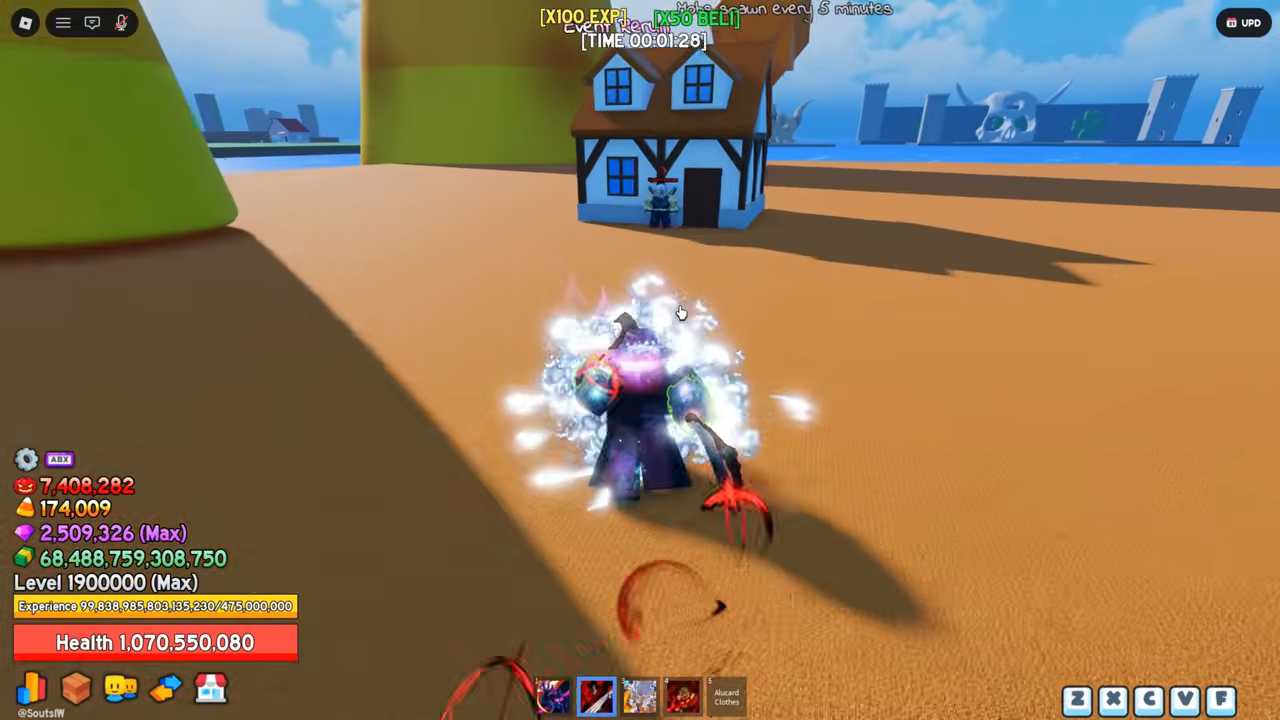
A player showcase of the Doraemon power, which sits in the auxiliary power slot (sức mạnh phụ), shows a letter-keyed skill layout:
- Z fires an air cannon projectile.
- X is a moveable damage skill the showcase calls very good for farming the mobs new players fight.
- C summons the magic door (cánh cửa thần kỳ), which teleports you to any island you choose.
- V is a flight skill.
That Z-X-C-V layout was shown for Doraemon specifically. Other powers ship with their own skill sets under their own names, and their keybindings weren't shown, so open your power's skill list and test each key to learn its actual binding.
Activating Haki
Once you own Haki, a Haki button appears on screen and toggles the buff on and off; when it is on, your character visibly changes — the showcase shows a white Haki coating. The button's exact position and label can vary between UI versions, but with Haki owned, the toggle sits on your HUD. The steps for earning Haki in the first place are on the how to get Haki page.
The stat-point condition that makes Haki work
Haki buffs every type of combat power you use, but only once you have allocated stat points. In the recorded test, damage stayed at 15 with Haki switched on before any points went into stats; after the player bought and allocated stats, the Haki bonus applied to the power being used. Without allocated stat points, Haki adds no damage bonus at all.
So whatever power you fight with — melee, sword, special or fruit — put stat points into that power, because the Haki buff only reaches powers whose stats you have raised. For more on stat points, see the stats and buffs guide.
The Rainbow Buso upgrade
The catalog also lists a direct Buso upgrade: Rainbow Buso [OP], a 150 Robux gamepass. Per its catalog description it grants an OP buff, unlocks Buso for free, makes Normal Buso give a 20% buff to all stats, and Rainbow Buso give a further 20% buff to all stats. As with every catalog entry, the price and effects belong to the current game version, so confirm them in the in-game listing. Related coverage continues on the Rainbow Haki page.
Related Jood Piece guides
- Jood Piece tier list — compare powers before you buy.
- Jood Piece gamepasses — the full catalog of purchasable powers.
- Jood Piece NPC locations — track down the island NPCs that grant powers.
- Jood Piece damage guide — how damage comes together.
- Jood Piece builds — combine powers, stats and Haki into one setup.